


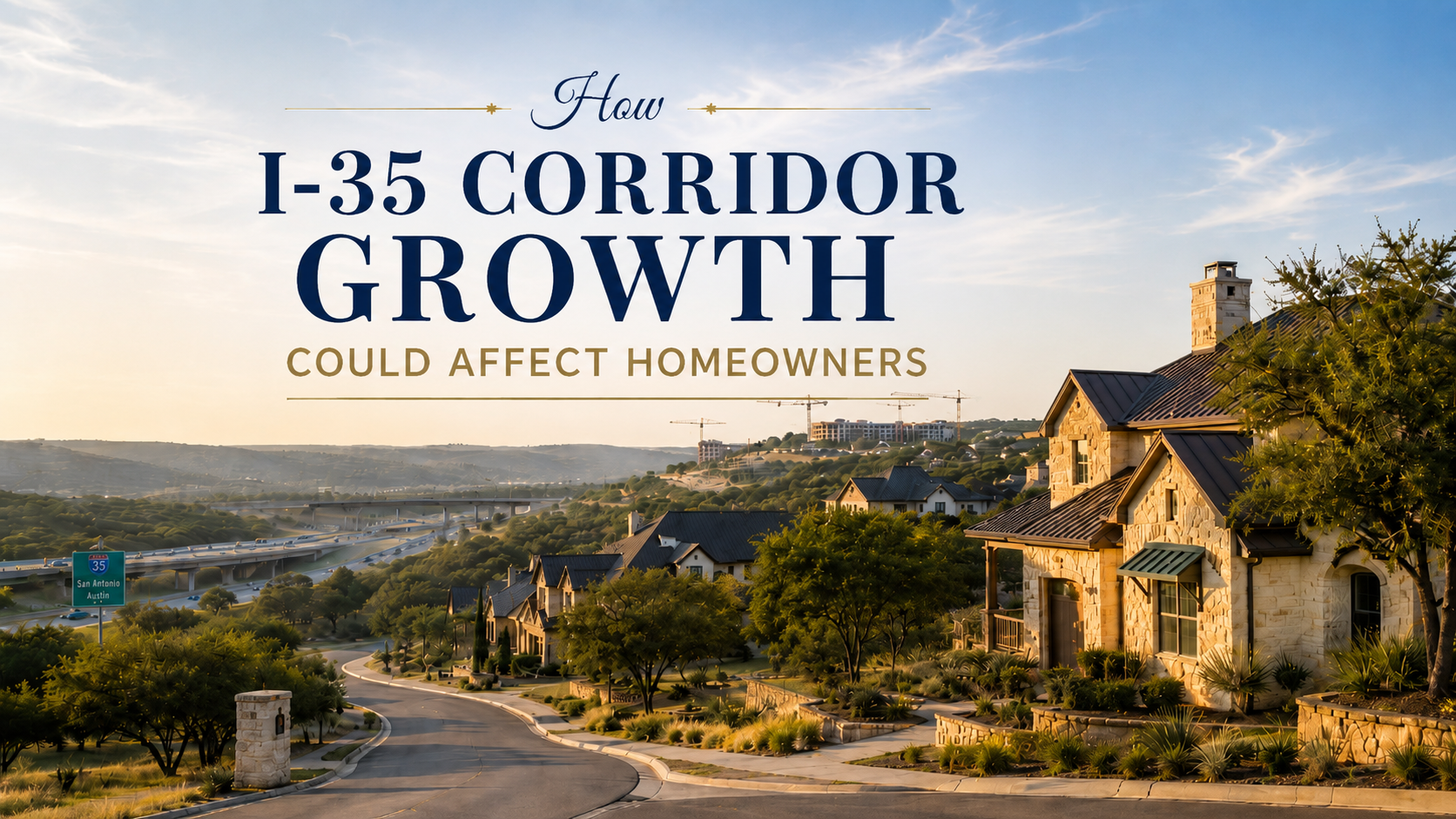
If you live anywhere near the I-35 corridor between Northeast San Antonio and New Braunfels, you have probably felt it already.
More traffic. More construction. More rooftops. More restaurants, retail centers, distribution space, hotels, and mixed-use development. More people moving into communities that used to feel quieter, smaller, and more spread out.
For homeowners in Schertz, Cibolo, New Braunfels, Live Oak, Selma, Universal City, Northeast San Antonio, and nearby areas like Garden Ridge, this growth can bring both opportunity and frustration.
The big question is not simply whether growth is “good” or “bad.”
The better question is:
How could I-35 corridor growth affect your home, your neighborhood, your daily life, and your long-term real estate plans?
Here are the key things local homeowners should be watching.
The I-35 Corridor Is Becoming More Connected — and More Crowded
The stretch of I-35 between San Antonio and Austin has become one of the most active growth corridors in Texas. It connects major job centers, military installations, suburbs, retail hubs, industrial development, and fast-growing communities.
That growth is one reason TxDOT is moving forward with the I-35 Northeast Expansion, often called I-35 NEX. The program includes improvements along approximately 20 miles of I-35 from North Walters Street to FM 1103 across Bexar, Comal, and Guadalupe counties. Portions of the project run through Northeast San Antonio, Live Oak, Selma, and Schertz.
For homeowners, this matters because roads shape real estate. Access, commute times, visibility, commercial growth, and traffic patterns can all affect how people perceive an area.
A home that once felt “just outside the city” may now feel more connected. A neighborhood that once had limited nearby services may suddenly have more restaurants, shopping, medical offices, and employment centers nearby. At the same time, that same growth may bring more congestion, noise, construction, and daily disruption.
Growth Can Improve Convenience
One of the biggest benefits of corridor growth is convenience.
As more people move into Schertz, Cibolo, New Braunfels, and Northeast San Antonio, businesses tend to follow. New grocery stores, restaurants, medical offices, hotels, entertainment options, retail centers, and service businesses often appear where population and traffic counts are increasing.
For homeowners, this can be a real lifestyle improvement. A shorter drive to groceries, dinner, healthcare, fuel, fitness, childcare, or shopping can make daily life easier.
New Braunfels is a good example. Commercial activity around Creekside and Mayfair has continued to expand, including major retail growth and the opening of a large Costco in the Mayfair area. That type of development can make the area more convenient not just for New Braunfels residents, but also for nearby communities along the corridor.
Schertz and Cibolo homeowners may also benefit from stronger commercial access along I-35 and FM 3009, while still living in residential areas that feel more neighborhood-focused than urban.
Convenience is one of the reasons corridor communities remain attractive to many residents.
Growth Can Also Bring Traffic and Construction Fatigue
The tradeoff is obvious: more growth usually means more traffic.
Homeowners near I-35, Loop 1604, FM 3009, FM 1103, Pat Booker Road, Schertz Parkway, and major retail corridors may feel this more than others. Construction phases can temporarily change drive times, ramp access, frontage road flow, and daily routines.
This is especially important for households commuting to Randolph AFB, Fort Sam Houston, downtown San Antonio, New Braunfels, Austin, or the broader I-35 corridor.
A homeowner may love the long-term convenience of improved road access but still feel frustrated by short-term construction. Ramp closures, detours, lane shifts, and frontage road changes can affect daily life for months or even years.
That does not necessarily hurt long-term value, but it can affect quality of life while the work is happening.
Property Values May Benefit — But Not Automatically
A common assumption is that growth always increases property values. Sometimes it does, but the reality is more specific.
Growth can support values when it improves convenience, access, employment, and overall demand for an area. A home in a well-kept neighborhood near good roads, schools, shopping, and job centers may become more attractive as the area grows.
But growth can also create concerns if a property is too close to heavy traffic, commercial loading areas, elevated roadways, industrial uses, or noisy intersections.
For example, two homes in the same general city can experience growth very differently:
A home tucked into a quiet Schertz neighborhood may benefit from better nearby retail access.
A home backing to a busy corridor may face more noise or visual impact.
A Cibolo home with convenient access to FM 1103 may become more appealing as nearby services expand.
A New Braunfels home near major retail may benefit from convenience but also see more traffic.
A Northeast San Antonio home near road improvements may become more connected but deal with construction disruption first.
This is why homeowners should avoid broad assumptions. The local impact depends on location, street position, noise exposure, access, neighborhood condition, school boundaries, and competing development nearby.
Commercial Growth Can Change Neighborhood Perception
Real estate is not just about the house. It is also about how people perceive the area around the house.
When a corridor gains new restaurants, grocery stores, medical offices, schools, parks, retail centers, and employment options, it can make surrounding neighborhoods feel more complete and more desirable.
That can be a positive for homeowners.
But too much commercial pressure can also change the feel of a community. Some residents may worry that an area is losing its small-town or suburban character. Others may welcome the access and convenience.
This is especially true in places like Schertz, Cibolo, New Braunfels, and Garden Ridge, where many residents value a balance between convenience and space.
For homeowners, the key is to pay attention to what kind of growth is happening. A grocery store, medical office, or neighborhood retail center may affect an area differently than a large warehouse, industrial site, or high-traffic entertainment venue.
Schools and City Services May Feel the Pressure
As more residents move into corridor communities, schools, roads, utilities, emergency services, parks, and city planning all have to keep up.
This can affect homeowners in several ways.
School districts may adjust attendance zones, build new campuses, or experience enrollment pressure. Cities may need to invest in drainage, road improvements, public safety, and utility infrastructure. County and city tax decisions may also become more important as communities work to serve growing populations.
For homeowners, this does not mean growth is bad. It means growth should be watched carefully.
A strong, well-managed growth pattern can help support long-term community value. Poorly planned growth can create frustration, congestion, and pressure on public services.
Larger-Lot and Established Neighborhoods May Become More Valuable to Some Buyers
As the corridor becomes busier, certain property types may become more appealing.
Established neighborhoods with mature trees, larger lots, quieter streets, and a little more breathing room may stand out more as nearby areas become denser.
That could be meaningful for communities like Garden Ridge, older parts of Schertz, certain New Braunfels neighborhoods, and established Northeast San Antonio areas.
Not every buyer wants to be in the middle of the newest retail and development. Some want access to it without living directly inside it.
That balance — convenience without feeling crowded — can be a major selling point for certain neighborhoods.
What Homeowners Should Watch
If you own a home along or near the I-35 corridor, here are a few things worth monitoring:
1. Road projects and access changes
Pay attention to ramp closures, frontage road changes, new exits, turnarounds, and major construction timelines. Access can influence both daily life and future buyer perception.
2. Nearby zoning and development requests
Commercial, multifamily, industrial, and mixed-use projects can affect traffic, noise, views, and neighborhood feel. City council and planning agendas are often worth watching.
3. School district growth
Enrollment changes, new campuses, and attendance boundary adjustments can affect how families evaluate neighborhoods.
4. Noise and traffic exposure
Homes near major roads, frontage roads, rail lines, commercial sites, or industrial areas may be affected differently than homes deeper inside neighborhoods.
5. Comparable sales
Do not assume growth is helping or hurting your home. Look at actual nearby sales, days on market, buyer feedback, and competing listings.
6. Home condition
As an area grows, buyers may compare your home against newer construction or recently updated homes nearby. Maintenance, curb appeal, roof age, HVAC condition, flooring, paint, and landscaping may become more important.
What This Means for Future Sellers
Even though this topic is not only about selling, homeowners should understand how growth can affect future selling strategy.
If your neighborhood is benefiting from better access, stronger retail, and increased demand, that can be part of the story when you eventually sell.
If your home is affected by road noise, construction, traffic, or nearby commercial activity, the strategy may need to be different. Pricing, presentation, disclosure, timing, and marketing language matter.
The goal is not to ignore growth or overstate it. The goal is to explain the property honestly and position it well.
What This Means for Long-Term Homeowners
If you plan to stay in your home, corridor growth still matters.
It can affect your commute, your errands, your property taxes, your insurance considerations, your neighborhood feel, and your long-term satisfaction.
Some homeowners may decide that growth makes their location more convenient than ever. Others may begin to wonder whether they want more space, less traffic, or a quieter setting.
Neither response is wrong. The important thing is to evaluate your home in the context of how your area is changing.
Bottom Line
I-35 corridor growth is reshaping Northeast San Antonio, Schertz, Cibolo, New Braunfels, and surrounding communities.
For homeowners, that growth can bring better access, more conveniences, stronger demand, and new neighborhood energy. It can also bring traffic, construction fatigue, noise, infrastructure pressure, and changing community character.
The impact is not the same for every home.
A property’s location, lot position, neighborhood, condition, school district, commute access, and nearby development all matter.
If you are wondering how growth along the I-35 corridor could affect your home, your neighborhood, or your long-term plans, Correa Realty Group can help you look at the local details with clarity.
We live and work in this region, and we understand that real estate is not just about a house. It is about how the area around the house is changing — and what that means for your next chapter.
FAQs
Is I-35 growth good for homeowners in Schertz and Cibolo?
It can be, especially when growth brings better access, more services, and stronger demand. However, the impact depends on the home’s exact location, traffic exposure, neighborhood condition, and nearby development.
Will the I-35 NEX project increase home values?
Road improvements may help long-term mobility and access, but they do not automatically increase every home’s value. Homes affected by noise, construction, or traffic may be viewed differently than homes that benefit from improved convenience.
How could New Braunfels growth affect homeowners?
New Braunfels growth may improve access to shopping, restaurants, jobs, and services, but it can also increase traffic and development pressure. Homeowners should watch nearby commercial projects, road improvements, and neighborhood-level demand.
Should homeowners near I-35 be concerned about noise?
Noise can matter, especially for homes close to frontage roads, elevated lanes, commercial areas, or high-traffic intersections. Homes deeper inside neighborhoods may experience less direct impact.
How can I find out if nearby development could affect my home?
Start by watching city planning agendas, zoning requests, TxDOT project updates, and nearby commercial development news. A local real estate professional can also help you evaluate comparable sales and buyer perception in your specific area.
Check out this article next