


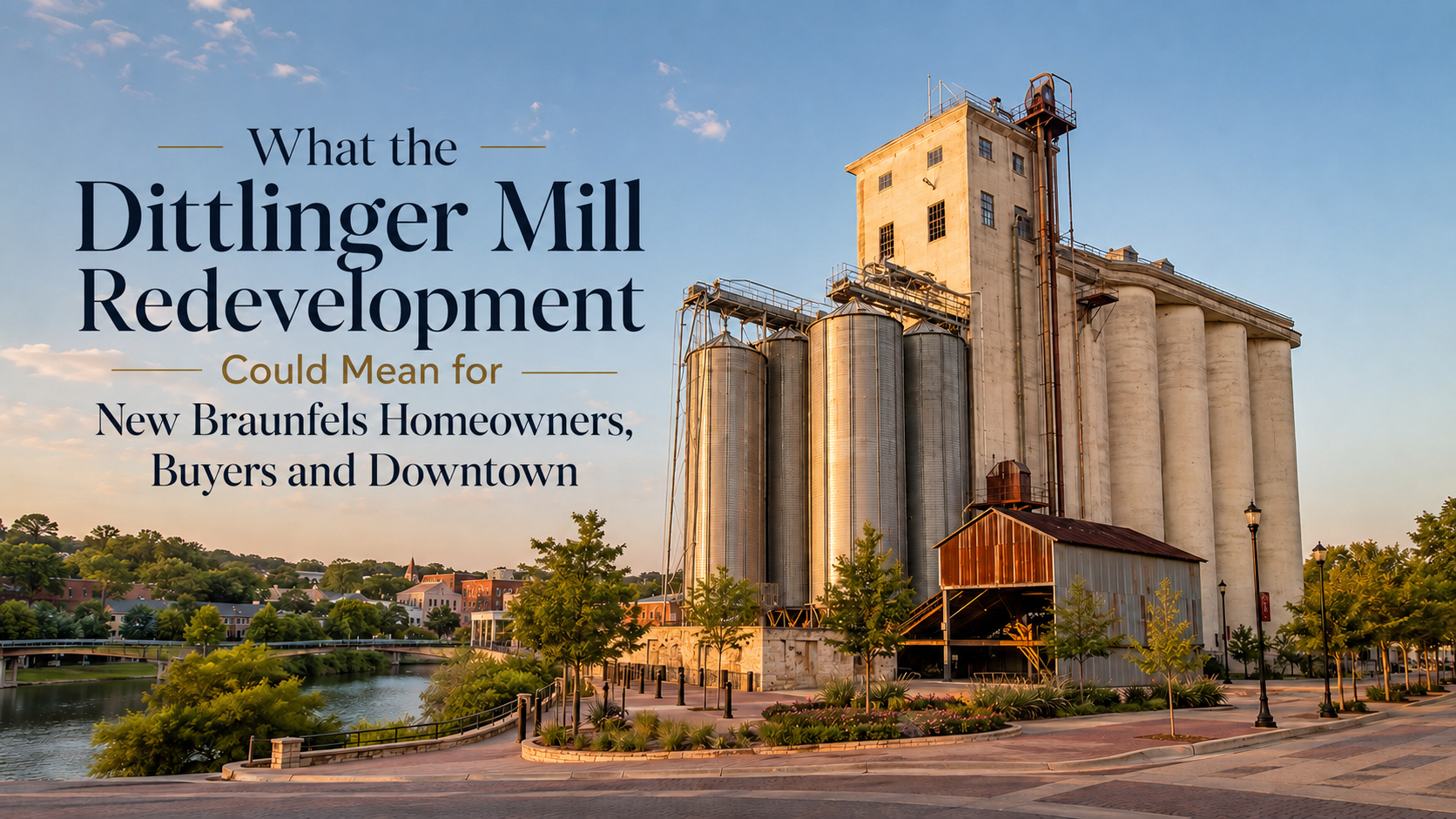
For generations, the Dittlinger Mill has been part of the physical landscape of New Braunfels.
The mill's story reaches back to 1886, when Hippolyt Dittlinger and Peter Faust established Dittlinger Mills. What began as an industrial operation powered from the Comal River eventually became part of ADM Milling and remained in operation until the facility closed in March 2023 after roughly 137 years.
Now, the property is preparing for a very different chapter.
Oxbow Development Group, the developer associated with the redevelopment of San Antonio's Pearl, is planning a mixed-use district around the former mill. Its latest concept includes apartments, restaurants, retail, office space and a large parking garage while preserving portions of the historic industrial property. Oxbow says it has assembled or is assembling approximately 11 acres around the original mill site.
For New Braunfels homeowners and buyers, however, the most important question isn't simply what is being built?
It's:
What could a project of this scale actually mean for downtown, nearby homes and the way people experience New Braunfels?
There are several potential answers—but there are also important reasons not to get ahead of what has actually been approved.
What Is Actually Planned for the Dittlinger Mill?
The redevelopment has moved considerably beyond the rumor stage.
In December 2024, New Braunfels approved rezoning associated with the former ADM/Dittlinger property. Then, on May 11, 2026, City Council gave final approval to rezoning approximately another 2.1 acres so they could be incorporated into the broader project. City documents describe the intended redevelopment as a walkable mixed-use project that may include residential uses, restaurants, retail, offices, a hotel and structured or surface parking.
The latest plans announced by Oxbow in August emphasize:
- Apartments
- Restaurants
- Retail
- Office space
- A large parking garage
- Adaptive reuse of the existing mill
- Preservation or incorporation of historic silos and tanks
- Public programming and gathering spaces
- Improved connections between downtown and the Comal River
Oxbow has also discussed possibilities such as a farmers market, live entertainment and other community programming.
One important distinction: rezoning approval does not mean every rendering or concept is the final site plan.
The developer has said it hopes to refine its plans by the end of 2026. A public listening session is scheduled for August 25, 2026, at the New Braunfels Civic & Convention Center to gather community input.
That means this is a legitimate redevelopment project with important approvals already in place—but many details can still change.
Why Does the Dittlinger Property Matter So Much to Downtown New Braunfels?
Location.
The site sits less than a quarter-mile from Main Plaza and close to the Comal River. City planning documents specifically identify the surrounding area as part of the walkable downtown environment.
For decades, however, a large industrial property effectively occupied part of the transition between downtown and the river.
That is one reason the redevelopment fits into goals New Braunfels has discussed for years.
The City's Downtown Implementation Plan and broader planning policies call for more infill development, additional downtown residents, pedestrian-oriented businesses, preservation of cultural resources and better utilization of large industrial properties within the downtown core.
So the bigger story isn't simply that an old mill is getting new tenants.
The project could help extend the active downtown environment east toward the Comal River.
If that happens successfully, someone might eventually be able to move more naturally between Main Plaza, shops and restaurants, the Dittlinger property and river-oriented spaces without each feeling like a separate destination.
Could the Redevelopment Increase Nearby Home Values?
Possibly—but homeowners should be cautious about anyone promising that it will.
Real estate values are influenced by many variables: the specific property, condition, supply and demand, interest rates, taxes, insurance costs, comparable sales, lot characteristics and what buyers are willing to pay at that particular time.
A major redevelopment can change the amenity profile of an area. Some buyers may place additional value on being able to walk to restaurants, shops, public spaces and entertainment.
Other buyers may be more concerned about traffic, visitor activity, noise, building density or being close to an active commercial district.
That means two houses a few streets apart could respond differently depending on their location and exposure.
A new development does not automatically create an equal increase in property value for every nearby home.
That is especially important while the Dittlinger project remains years away from completion.
For homeowners considering selling during the development period, the better approach is to price a property based primarily on current market evidence and existing amenities, rather than asking buyers to pay today for improvements that may not arrive for several years.
What Should Nearby Homeowners Pay Attention To?
For owners closer to downtown, East San Antonio Street, Market Avenue and the river, several details deserve attention as the plans progress.
Traffic and parking
A successful retail, restaurant and entertainment destination naturally attracts people.
The City has already required a parking-demand study before building permits are issued, and current development standards require parking structures facing public streets or pedestrian areas to incorporate active uses, landscaping or other design features instead of presenting a blank garage façade.
Earlier development concepts included roughly 400 parking spaces; more recent descriptions have referenced 500 or more spaces, so parking remains an important part of the planning process.
Building scale and neighborhood compatibility
The approved development standards include specific protections where new development abuts existing one- to four-family residential uses.
Those provisions include setbacks and stepped building-height limitations as development approaches residential properties, along with restrictions and screening requirements for equipment, loading docks, trash facilities and similar uses that can create noise, odors or visual impacts.
Those details matter considerably more to nearby homeowners than a rendering viewed from several hundred feet away.
Construction
Even a project that ultimately improves an area can create short-term inconvenience.
A multi-year redevelopment of an industrial site can involve demolition, infrastructure work, utility construction, trucks, temporary road changes and construction noise.
Anyone buying very close to the project should understand both the future vision and the construction period required to get there.
What Does the Redevelopment Mean for Buyers Considering Downtown New Braunfels?
Buyers should separate three things:
what exists today, what zoning permits, and what the developer currently intends to build.
They are not always identical.
Before purchasing close to a major redevelopment, consider:
- How close is the property to proposed commercial activity?
- Could future buildings affect views or privacy?
- Where are vehicle entrances likely to be?
- What does the approved zoning allow?
- What parking and pedestrian improvements are planned?
- Could construction affect access for several years?
- Are floodplain or drainage conditions relevant to the property being purchased?
- How could increased downtown activity fit your preferred lifestyle?
For some buyers, more restaurants, shops and walkability may be exactly what they want.
Others may intentionally prefer more separation from downtown activity.
Neither preference is inherently better. The goal is to understand what you're buying before the surroundings change.
Is This Really Going to Be New Braunfels' Version of the Pearl?
There is an obvious comparison, but it deserves some restraint.
Oxbow Development Group is associated with San Antonio's Pearl, and the Dittlinger concept shares several characteristics with that project: adaptive reuse of historic industrial buildings, restaurants and retail, residential uses, public gathering spaces and an emphasis on preserving the history of the property.
Oxbow has specifically said it wants to preserve the mill and elements such as its silos and tanks while telling the story of the Dittlinger family.
But New Braunfels isn't San Antonio, and the Dittlinger Mill isn't the Pearl Brewery.
Different land, infrastructure, economics, surrounding neighborhoods, river conditions, tenants and community expectations will shape what ultimately succeeds here.
Calling it “the next Pearl” may be an easy shorthand.
A more accurate description today is:
The Dittlinger redevelopment is a historic adaptive-reuse project being led by a developer with significant experience creating a mixed-use district around historic industrial buildings.
What it ultimately becomes will be distinctly New Braunfels.
Could the Project Improve Downtown Walkability?
That is clearly one of the goals.
New Braunfels' planning documents have repeatedly emphasized pedestrian-oriented development, more downtown residents and improved connectivity. The approved Dittlinger zoning incorporates those objectives, including public entrances along San Antonio Street and provisions allowing sidewalks, outdoor seating, linear parks and other pedestrian-oriented spaces between buildings and public rights-of-way.
Oxbow has also expressed interest in strengthening the connection between downtown and the river.
If those connections are executed well, one of the redevelopment's most meaningful long-term effects may be less about any particular restaurant or store and more about how people move through downtown New Braunfels.
What About Downtown Parking?
Parking will probably remain one of the issues residents watch most closely.
New Braunfels already changed its downtown parking program in 2025. Approximately 238 of downtown's roughly 750 on-street spaces transitioned into the paid parking system, with the first hour free and subsequent time subject to fees.
Adding a major destination east of Main Plaza creates another layer to that conversation.
A large parking structure could add substantial capacity, but actual parking demand will depend on the final combination of apartments, offices, restaurants, retail, hotel space—if included—and event programming.
That's why the required parking study may ultimately be more informative than today's conceptual parking count.
What Does the Downtown TIRZ Mean for Property Owners?
The Dittlinger property lies inside New Braunfels Tax Increment Reinvestment Zone No. 3, which covers downtown. City staff has stated that additional taxable value generated by redevelopment can produce revenue that is reinvested in downtown improvements such as roads and sidewalks.
A TIRZ is sometimes misunderstood.
Being inside a TIRZ does not create a new property-tax rate.
Texas Comptroller guidance explains that tax increment financing redirects part of the taxes generated by increases in taxable value within the zone toward eligible improvements. The designation itself does not change the tax rate. Property owners' bills can still change if their appraised values or tax rates change, just as they can elsewhere.
That distinction is particularly useful for homeowners trying to understand headlines about public participation in redevelopment projects.
When Could the Dittlinger Mill Redevelopment Be Finished?
There is not yet a fixed completion date.
As of August 2026, Oxbow has said it hopes to work through the plans by the end of the year, followed by approximately 18 months of design and then roughly 2½ years of construction.
Those are developer expectations—not a guaranteed schedule.
Large redevelopment projects can change because of design, infrastructure, financing, permitting, environmental considerations, tenant commitments and construction conditions.
The practical takeaway for homeowners and buyers is simple:
Think of Dittlinger as a multi-year transformation, not something that will change downtown overnight.
What Should New Braunfels Residents Watch Next?
The most useful information over the next stages will be more specific than another conceptual rendering.
Watch for:
- The final development program
- Apartment and hotel counts, if applicable
- Final building heights and placement
- Parking-demand study results
- Traffic and access plans
- Pedestrian connections
- Drainage and floodplain engineering
- Public infrastructure agreements
- Construction phasing
- Restaurant and retail announcements
- Details on public spaces and river access
Oxbow has acknowledged that the riverfront site presents floodplain and infrastructure challenges and has discussed possible public-private participation for infrastructure such as sidewalks and drainage.
Those details will tell homeowners considerably more about the real-world impact of the project than its name or branding.
What Could This Mean for Garden Ridge, Schertz, Cibolo and the San Antonio–New Braunfels Corridor?
The direct real-estate impact will be concentrated in New Braunfels, particularly around downtown.
A homeowner in Garden Ridge or Cibolo should not expect the Dittlinger redevelopment alone to materially determine the value of a home miles away.
Its regional significance is different.
New Braunfels sits along an increasingly interconnected San Antonio–Austin corridor. A stronger downtown destination can add another amenity to the larger lifestyle equation for people considering communities such as New Braunfels, Garden Ridge, Schertz and Cibolo.
That may strengthen the regional appeal of New Braunfels as a destination, but home values still need to be evaluated at the neighborhood and property level—not based on one development announcement.
A New Chapter for an Old New Braunfels Landmark
Few redevelopment opportunities combine industrial history, downtown proximity and river frontage the way the Dittlinger property does.
That makes the project important.
It also makes careful planning important.
The encouraging part of the current proposal is that the mill's history is not being treated simply as something to demolish and replace. Oxbow has stated that it intends to preserve parts of the historic property and incorporate the Dittlinger story into the redevelopment.
Whether the result ultimately improves downtown will depend on the details: architecture, parking, traffic, public spaces, local businesses, river access and the relationship between the new development and existing neighborhoods.
For homeowners and buyers, that is the important lesson.
Follow the project—but make real-estate decisions based on what is confirmed, what a property is worth today and how future development fits your individual plans.
How Correa Realty Group Can Help
Major redevelopment projects can make buying or selling nearby more complicated because today's property needs to be evaluated alongside tomorrow's possibilities.
Correa Realty Group can help buyers understand nearby zoning, current comparable sales, redevelopment plans, floodplain and drainage considerations, property taxes, access and other factors that may affect a particular property.
For homeowners thinking about selling, we can also help separate legitimate market value from speculation surrounding future development—so your pricing and marketing strategy reflects what today's buyers are actually willing to pay.
We serve New Braunfels, Garden Ridge, San Antonio, Schertz, Cibolo and surrounding Texas Hill Country communities, with an emphasis on helping clients understand not only the property itself, but the community and changes happening around it.
If you're considering buying or selling in New Braunfels and wondering how the Dittlinger redevelopment—or another nearby project—could factor into your decision, contact Correa Realty Group. We're happy to help you look at the details and determine what makes sense for you.
6. FAQs
What is being built at the Dittlinger Mill in New Braunfels?
The Dittlinger Mill property is being planned as a mixed-use redevelopment incorporating residential, restaurant, retail and office uses along with significant parking and preservation of portions of the historic mill. City zoning also allows uses including a boutique hotel, although Oxbow's latest August 2026 description focused on apartments, restaurants, retail, offices and parking. The final development program is still being refined.
Is the Dittlinger Mill redevelopment going to be like the Pearl in San Antonio?
There are similarities, but it is too early to call the project another Pearl. Oxbow Development Group is associated with San Antonio's Pearl, and both projects emphasize adaptive reuse, historic preservation, dining, retail, residential activity and public gathering spaces. However, New Braunfels has a different scale, market, riverfront setting and surrounding neighborhoods, so the final Dittlinger development will have its own identity and challenges.
Will the Dittlinger redevelopment increase New Braunfels home values?
The redevelopment could make certain nearby locations more appealing to buyers who value walkability, dining, shopping and downtown amenities, but an increase in home value is not guaranteed. Property condition, location, comparable sales, interest rates, taxes, insurance, traffic and proximity to commercial activity can all influence value. Homes closest to the development may experience different effects than homes elsewhere in New Braunfels.
Will homeowners pay higher property taxes because of the Dittlinger TIRZ?
A TIRZ itself does not impose a new property-tax rate. The Texas Comptroller explains that tax increment financing redirects a portion of taxes generated by increases in property values within the designated area to fund improvements inside that zone. A homeowner's tax bill can still rise if the property's taxable value or applicable tax rates change, but the TIRZ designation itself does not establish an additional tax rate.
When will the Dittlinger Mill redevelopment be finished?
There is no guaranteed completion date. As of August 2026, Oxbow expects to refine plans through the end of 2026, followed by approximately 18 months of design and about 2½ years of construction. Large redevelopment schedules frequently change, so buyers and homeowners should treat that as a current planning estimate rather than a promised opening date.
Will the Dittlinger Mill project make downtown New Braunfels traffic worse?
Additional development is likely to change traffic and parking demand, but the magnitude cannot be known until the final uses and site design are established. The City's approved development standards require a formal parking-demand study before building permits are issued. A large parking structure is also contemplated. Access points, construction phasing and the final mix of residential, restaurant, office and entertainment uses will help determine the actual impact.
Could the Dittlinger redevelopment affect homeowners in Garden Ridge?
Any direct effect on Garden Ridge home values should be limited because Garden Ridge is a separate market several miles from downtown New Braunfels. The project could still have regional relevance by adding another dining, entertainment and recreation destination to the broader New Braunfels–Garden Ridge–Schertz corridor. Garden Ridge values, however, should continue to be evaluated using Garden Ridge-specific comparable sales and market conditions rather than the Dittlinger project.
What does the project mean for people moving from San Antonio to New Braunfels?
The redevelopment could add to the differences buyers already consider when comparing San Antonio-area communities with New Braunfels. A more active and connected downtown may appeal to buyers who value local restaurants, historic architecture, river access and walkability. But purchasers should also evaluate commute patterns, taxes, housing costs, traffic and the specific neighborhood rather than choosing a home primarily because of a future development.
When should I talk with a REALTOR® about buying or selling near the Dittlinger project?
Professional real-estate guidance becomes particularly useful when a property is close enough to the redevelopment that zoning, future building locations, traffic, construction, floodplain considerations or changing amenities could affect a purchase or sale decision. A local REALTOR® can compare actual sales, review available planning information and help distinguish confirmed development facts from assumptions that should not be built into a property's price.
Check out this article next