



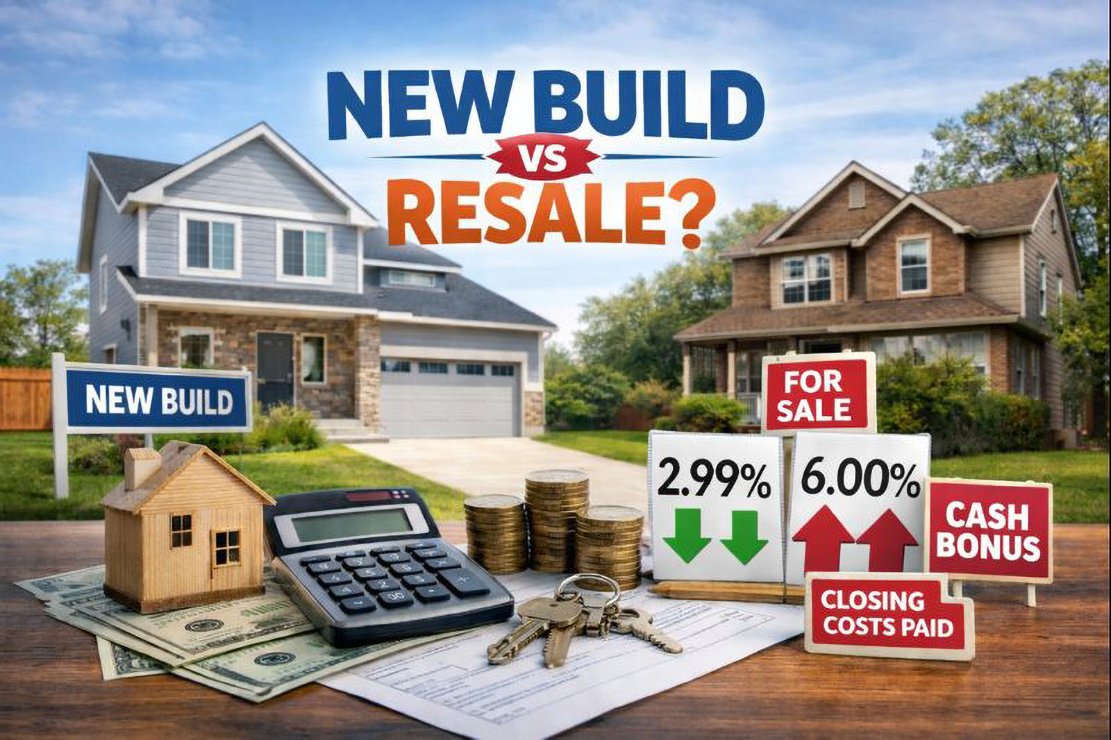
New Build vs Resale: The “Real Math” That Makes the Decision Clear (Incentives Included)
If you’ve been house-hunting in San Antonio, New Braunfels, Schertz/Cibolo, Garden Ridge—or anywhere in our Hill Country corridor—you’ve probably noticed something: new construction pricing has gotten more competitive, and builder incentives can be the deciding factor.
That’s not just your imagination. National data shows builders are leaning hard on incentives to move inventory, with a record share offering them.
But here’s the catch: most buyers compare sticker price to sticker price, when the smarter comparison is:
- Cash to close
- Monthly payment
- Total cost of ownership
- Risk (repairs, surprises, timeline)
Let’s walk through the exact math we use with our buyers to make this decision confidently.
Why this topic is “hot” right now
Builders across the country have been using incentives—sometimes aggressively—to keep monthly payments attractive and move completed homes.
In practice, that often looks like:
- Mortgage rate buydowns
- Closing cost credits
- Design/upgrade allowances
- Price reductions on quick move-in homes
You’ll even see builders publish rate promotions and explain that the lower rate is achieved through buying points (a buydown).
———————————
Step 1: Stop comparing “price.” Start comparing “payment + cash to close.”
A resale home might be $15,000 cheaper than a new build… but if the new build comes with incentives that reduce your rate or cover closing costs, the monthly payment (and the money you need up front) can flip the outcome.
The two buckets of “incentives”
1) Real dollars that reduce what you bring to closing
- Closing cost credits (builder or lender)
- Prepaids contributions (sometimes)
- Title fee credits (occasionally, often tied to preferred providers)
2) Financing incentives that change your interest rate
- Temporary buydowns (like 2-1 or 3-2-1)
- Permanent buydowns (points paid upfront to lower the rate long-term)
It’s important to understand: points and lender credits are real tradeoffs. Paying points can reduce your rate; taking lender credits can reduce your upfront costs in exchange for a higher rate.
Step 2: Do an apples-to-apples “New Build vs Resale” worksheet
Here’s the exact checklist we use (you can copy/paste this into your notes):
A) Purchase & financing
- Purchase price (new build vs resale)
- Down payment amount
- Loan type (Conventional / FHA / VA)
- Estimated interest rate with incentives
- Estimated interest rate without incentives
- Rate lock timeline (especially if the new build won’t be done for months)
B) Incentives (itemized)
For new builds:
- Closing cost credit ($____)
- Rate buydown (temporary or permanent) value ($____)
- Design center/upgrade credit ($____)
- Lot premium credits or price reductions ($____)
- Any conditions: preferred lender/title or must close by ___ date
For resale:
- Seller concessions ($____)
- Repair credits ($____)
- Price reduction ($____)
C) Monthly ownership costs (this is where Texas gets real)
- Principal & interest (P&I)
- Property taxes (estimate based on future assessed value + exemptions you may qualify for)
- Homeowners insurance
- HOA dues
- If applicable: MUD/PID or other special district costs
D) Risk & timeline
- Inspection findings (resale often has more “unknowns”)
- Builder warranty coverage (new build advantage)
- Time to move in (quick move-in vs longer build)
- Appraisal risk (especially when incentives are large)
Step 3: A real-world example (simple math, big clarity)
Example scenario (illustrative only):
Option 1 — New build
- Price: $380,000
- Incentive: $20,000 (used toward closing costs + rate buydown)
- Down payment: 10%
- Rate after buydown: lower than market (varies by program)
Option 2 — Resale
- Price: $365,000
- Seller concessions: $10,000
- Down payment: 10%
- Rate: standard market rate (depends on lender/credit/etc.)
Even with a higher purchase price, a permanent rate buydown can reduce payment enough to win—especially if you plan to keep the home for several years.
And yes—builders really do market this approach. For example, some Texas builders publish promos showing reduced rates achieved via points/buydowns (not “free money”), which is exactly what you want disclosed clearly.
Step 4: The incentive “fine print” that matters (a lot)
Builder incentives can be excellent—but only if you understand the rules.
1) “Must use preferred lender/title”
This is common. Sometimes the incentive is funded by the builder; sometimes it’s tied to an affiliate lender/title structure. Either way, you want your lender to itemize how the incentive is applied (closing costs vs points vs lender credits).
You’ll see local builders advertise incentives directly on their sites (example: closing cost offers or event-based promos).
2) Rate buydown vs lender credit: know the difference
- Discount points: you (or the builder) pay more upfront to reduce the rate.
- Lender credits: you pay less upfront, but accept a higher rate.
3) Temporary buydowns can be great—if your plan matches reality
A 2-1 buydown can lower payments in years 1 and 2, then payment increases in year 3. That can work well if:
- You expect income to rise,
- You plan to refinance (not guaranteed),
- Or you simply need breathing room early on.
Step 5: New build vs resale — what buyers often miss
New build “wins” when…
- Incentives materially reduce your monthly payment or cash-to-close
- You value predictable maintenance + builder warranties
- You can wait for completion (or find a quick move-in)
- You want modern layouts/energy features without renovation
Resale “wins” when…
- You want established neighborhoods, mature trees, larger lots, or specific school/commute areas
- You need to move quickly and don’t want construction timelines
- You want negotiation flexibility (repairs, credits, price)
- You’re willing to trade some maintenance risk for location/value
Nationally, even the Realtor® community has been highlighting that incentives and price cuts are shrinking the gap between new and resale in many markets.
———————————
Our best advice: ask for the “side-by-side net sheet” before you fall in love
When we help buyers compare new builds and resales, we don’t guess.
We request:
- The builder incentive sheet (or written offer)
- A lender worksheet showing incentives applied (points, credits, closing costs)
- A resale estimate including inspections/repairs and seller concessions
- A clean monthly comparison including taxes/HOA/insurance
That’s the real math. And once you see it laid out, the decision usually becomes obvious.
Want us to run the numbers for you?
If you tell us:
- Your target monthly payment range
- Areas you’re considering (San Antonio vs New Braunfels vs Schertz/Cibolo vs Garden Ridge, etc.)
- Whether you prefer new build, resale, or “open to either”
…we can help you build a true apples-to-apples comparison so you’re not making a $300,000+ decision based on a headline incentive.
Check out this article next