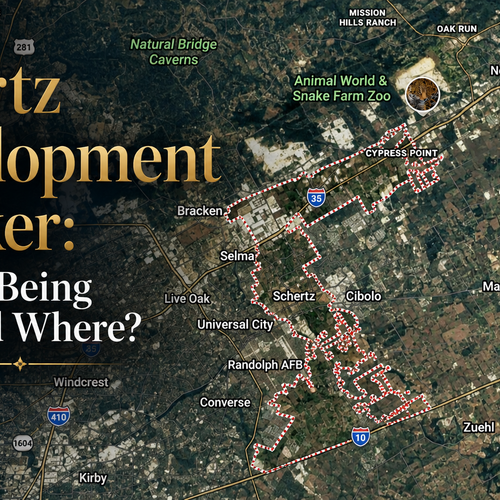



School information comes up frequently when people are looking for homes around Garden Ridge, Schertz, Cibolo, Northeast San Antonio, New Braunfels, Universal City, Converse, and the communities surrounding JBSA-Randolph.
The Texas Education Agency has now given buyers another set of information to consider.
TEA publicly released its 2026 A-F accountability ratings on August 14, 2026. Across Texas, 1,202 school districts and 9,105 campuses received ratings, with 85 percent of rated campuses earning a C or higher.
For four districts serving many of the communities where Correa Realty Group works, the preliminary 2026 district results are:
| School district | 2026 score | 2026 rating |
|---|---|---|
| Comal ISD | 88 | B |
| Schertz-Cibolo-Universal City ISD | 81 | B |
| North East ISD | 81 | B |
| Judson ISD | 71 | C |
Comal ISD reported an overall score of 88, with 18 campuses receiving an A and 14 receiving a B. SCUC ISD maintained an 81/B, with Steele High School earning an A and three campuses receiving distinction designations. North East ISD reported an overall 81/B. Judson ISD moved from a 69/D in 2025 to a 71/C in 2026, with 12 campuses improving their overall scores.
Those numbers are useful.
They are not enough, by themselves, to determine whether a particular home, school assignment, or community is right for a buyer.
One important detail: the August 2026 ratings are preliminary
TEA's August public release is part of the preliminary accountability process.
School districts have an opportunity to appeal their ratings. TEA's 2026 accountability calendar calls for final ratings to be released after the appeals process, currently scheduled for December 2026. Buyers researching a property later in the year should confirm that they are looking at the most current information available.
That distinction is especially important when a campus or district score is close to the cutoff between letter grades.
What does a Texas school accountability rating actually measure?
Texas does not create an A-F school rating from one test result.
The accountability system evaluates three broad areas:
- Student Achievement
- School Progress
- Closing the Gaps
Student Achievement considers measures such as STAAR performance and, for applicable schools, graduation and readiness for college, career, or the military.
School Progress looks at academic growth and relative performance.
Closing the Gaps examines performance among different student groups and includes measures tied to achievement, growth, graduation, English-language proficiency, and readiness.
For campus ratings, TEA generally gives 70 percent weight to the better result between Student Achievement and School Progress and 30 percent to Closing the Gaps, subject to additional accountability rules.
This is one reason a buyer can learn more by opening the detailed accountability information rather than stopping at the letter grade.
A B with strong academic growth may tell a different story than a B whose strongest component is Student Achievement. The overall letter does not show that distinction by itself.
District ratings are only the starting point
One of the easiest mistakes to make during a home search is comparing one district's letter grade with another district's letter grade and assuming the research is finished.
School districts can contain dozens of campuses.
Those campuses can have different ratings, different academic trends, different programs, and different grade configurations.
North East ISD illustrates this clearly. Its overall 2026 district rating is 81/B, while its published campus list includes individual schools receiving A, B, C, and Not Rated designations.
Judson ISD also shows how much can be hidden inside one district grade. The district improved to a 71/C in 2026, while several campuses made considerably larger individual gains. Escondido Elementary moved from 48 to 72, Masters Elementary moved from 59 to 78, and Judson Learning Academy increased from 83/B to 94/A.
A district rating tells you something about the district.
A property-specific school search tells you much more about the home you are actually considering.
How should homebuyers research the schools assigned to a house?
A more useful process starts with the address, not the city name.
1. Verify the school district using the exact property address
Do not assume that a home's city automatically tells you its school district.
This is particularly important around the San Antonio metropolitan area, where municipal boundaries, ZIP codes, and school district boundaries do not always line up in the way a buyer might expect.
TXschools.gov allows consumers to search for schools and districts and includes an address-based map and comparison tools.
The school district itself should remain the final source for current attendance assignments.
2. Identify the elementary, middle, and high school separately
Knowing the district is only the first step.
Find the current elementary, middle, and high school assigned to the specific property.
This can make a meaningful difference when comparing two houses that appear to be in the same general area.
Comal ISD, for example, publishes separate elementary, middle, and high school attendance boundaries. Its current Davenport High School information states that Davenport follows the Danville Middle School attendance area, including the Garden Ridge Elementary and Morningside Elementary feeder areas.
3. Review the individual campus rating
Once you know the assigned campus, look at that campus rather than relying solely on the district average.
Check:
- Overall A-F rating
- Numerical score
- Student Achievement
- School Progress
- Closing the Gaps
- Distinction designations
- Graduation and college, career, and military readiness information where applicable
This gives you a more complete picture of how the school earned its rating.
4. Look at the trend, not just 2026
One year can be affected by changes in student performance, accountability calculations, campus circumstances, or other factors.
TEA provides multi-year accountability information that allows families to look beyond one snapshot.
A campus moving from C to B over several years may raise different questions than a campus moving in the opposite direction. Neither trend alone tells you everything about the school, but both are worth understanding before making a long-term housing decision.
5. Research the programs that actually matter to you
A state rating cannot tell you whether a campus offers the academic or extracurricular opportunities important to your household.
Depending on your needs, you may want to research:
- Advanced academics
- Career and Technical Education
- Dual-credit opportunities
- Fine arts
- Athletics
- Gifted and talented programs
- Special education services
- Language programs
- STEM opportunities
- Transportation
- Before-school or after-school programs
Two schools with the same accountability rating may offer very different programs.
6. Check for attendance-boundary changes
This deserves particular attention in fast-growing areas.
New Braunfels, Cibolo, Schertz, and other communities along the I-35 corridor continue to add housing, and growing districts periodically open campuses or adjust attendance boundaries.
Comal ISD currently publishes both current boundaries and future 2027-28 middle-school attendance boundaries, which is a good example of the type of information buyers should look for before assuming today's assignment will remain unchanged indefinitely.
A school assignment shown in an MLS listing or real-estate portal should never replace verification with the district.
What should Garden Ridge buyers know about Comal ISD?
Garden Ridge is closely connected with Comal ISD. Garden Ridge Elementary is located on Municipal Parkway in the city, and the district publishes official attendance maps for the area.
Comal ISD's preliminary 2026 accountability score is 88/B. The district reported 18 A-rated campuses, 14 B-rated campuses, and 94 distinction designations. Davenport High School received a 95/A and earned all seven available distinction designations.
For a Garden Ridge buyer, however, the useful research does not stop with the district's 88.
Verify the property address, confirm all assigned campuses, review those campuses individually, and look at any proposed attendance changes.
That approach gives you property-specific information instead of a broad district assumption.
What should Schertz and Cibolo buyers know about SCUC ISD?
Schertz-Cibolo-Universal City ISD received an 81/B in the preliminary 2026 accountability ratings.
Steele High School received an A, three campuses received distinction designations, and 11 campuses improved or maintained their overall rating compared with 2025.
This makes campus-level research particularly useful for buyers comparing homes across Schertz and Cibolo.
Instead of searching only for "SCUC ISD rating," identify the campuses attached to each property and compare the actual data that matters to you.
A home search can cross several attendance zones even when the homes are relatively close together.
What should Northeast San Antonio buyers know about NEISD?
North East ISD received an 81/B for 2026.
Its official accountability summary lists individual campus results, which range across multiple rating levels. That variation reinforces the importance of researching the property address rather than using the district score as the only measure.
For buyers looking in North Central or Northeast San Antonio, school research should happen alongside other property-specific questions such as commute time, property taxes, insurance, home condition, neighborhood restrictions, and monthly payment.
The school score should be part of the research rather than the entire home-search strategy.
What should Converse and Randolph-area buyers know about Judson ISD?
Judson ISD's preliminary 2026 score improved to 71/C from 69/D in 2025.
Twelve campuses improved their overall scores, nine improved by at least one letter grade, and the percentage of campuses receiving an A, B, or C increased from 49 percent to 63 percent, according to the district.
That is a good example of why buyers should examine direction as well as the current letter grade.
A district score provides the snapshot.
Campus results and multi-year trends provide additional context.
Do school ratings tell you which community you should choose?
No single school rating can make that decision for you.
A household may place a high priority on a particular academic program. Another buyer may be focused on commute time, housing costs, lot size, proximity to JBSA-Randolph, access to medical facilities, extracurricular opportunities, or a specific campus assignment.
Real-estate professionals also need to approach school conversations carefully and consistently.
Current National Association of REALTORS® Fair Housing guidance emphasizes that consumers may receive accurate school information while agents must continue to avoid steering buyers toward or away from neighborhoods based on protected characteristics.
A useful REALTOR® should help you find objective information and ask better questions.
The decision about which schools, districts, programs, and communities meet your needs remains yours.
Can school ratings affect a home's resale potential?
School assignments can influence the way some buyers search for homes, which means they may be one of several factors affecting demand for a particular property.
There is no reliable formula that says a certain accountability score automatically adds a specific amount to a home's value.
Resale value is affected by many factors, including:
- Location
- Property condition
- Lot and home characteristics
- Comparable sales
- Inventory
- New-construction competition
- Property taxes
- Insurance costs
- Interest rates
- Neighborhood amenities
- Road access and commute patterns
- Buyer demand at the time of sale
School ratings can also change during the years you own the home.
Attendance boundaries can change as well.
For those reasons, buying a property solely because of a single year's school rating creates more risk than evaluating the entire property and its location.
A better way to compare homes
If schools are important to your move, create a simple research sheet for each property.
Record:
- Exact property address
- School district
- Assigned elementary school
- Assigned middle school
- Assigned high school
- Current campus ratings
- Previous years' results
- Programs important to you
- Transportation information
- Known or proposed attendance-boundary changes
Then compare the school information alongside the rest of the home.
Include price, property taxes, insurance, HOA costs, commute, condition, resale considerations, and the monthly payment.
That produces a much more useful home-buying decision than choosing between two district letter grades.
The takeaway for San Antonio-area homebuyers
The 2026 Texas school ratings provide useful new information for anyone considering Garden Ridge, Schertz, Cibolo, Northeast San Antonio, Universal City, Converse, New Braunfels, or nearby communities.
Comal ISD currently shows an 88/B, SCUC ISD an 81/B, North East ISD an 81/B, and Judson ISD a 71/C in the preliminary 2026 results.
The most useful research happens one level deeper.
Start with the exact property.
Confirm the assigned campuses.
Review the individual school data.
Look at the trend.
Check programs and future boundaries.
Then decide how that information fits alongside everything else that makes a house work for you.
How Correa Realty Group Can Help
Correa Realty Group does not rank schools or tell buyers which district or neighborhood they should choose.
We help buyers locate objective, property-specific information so they can make their own informed decisions.
If you are considering a home in Garden Ridge, San Antonio, New Braunfels, Schertz, Cibolo, or a surrounding community, we can help you identify the school district connected to the property, locate official attendance-zone resources, research taxes and monthly ownership costs, evaluate commute considerations, and understand how the home fits into the broader local market.
For relocating buyers, this can be particularly helpful when comparing several communities from a distance.
Our approach is simple: provide the information, explain the local context, and help you ask the right questions.
If you are considering a home and want help researching the property beyond what appears in the listing, contact Correa Realty Group. We would be happy to help you look at the details.
FAQs
What are the 2026 ratings for Comal ISD, SCUC ISD, NEISD, and Judson ISD?
The preliminary 2026 ratings are 88/B for Comal ISD, 81/B for Schertz-Cibolo-Universal City ISD, 81/B for North East ISD, and 71/C for Judson ISD. TEA publicly released the 2026 accountability ratings on August 14, 2026. The current ratings are part of the preliminary accountability process and may be affected by appeals before TEA releases final ratings.
Are the August 2026 Texas school ratings final?
No. The ratings released publicly in August 2026 are preliminary. Texas school districts have an opportunity to appeal accountability results. TEA's 2026 accountability calendar currently schedules final ratings for December 2026 after the appeal process is completed. Buyers should check TXschools.gov or the school district directly for the latest information, particularly if they are reading this article later in 2026.
What does a Texas A-F school rating measure?
Texas A-F accountability ratings combine several measures rather than relying on one test. TEA evaluates Student Achievement, School Progress, and Closing the Gaps. Depending on the school level, the system considers STAAR performance, academic growth, graduation outcomes, college, career, and military readiness, and performance among different student groups. The detailed domain scores can often provide more useful context than the letter grade alone.
What school district should Garden Ridge homebuyers research?
Garden Ridge buyers will commonly be researching Comal ISD, which operates Garden Ridge Elementary and publishes official attendance boundaries for the area. Comal ISD received a preliminary 88/B for 2026. Buyers should still verify the current elementary, middle, and high school assignments for the exact property address because attendance boundaries and feeder patterns can change.
How should I compare schools when buying a home around San Antonio?
Start with the exact property address and identify the assigned elementary, middle, and high schools. Review each campus's current rating, accountability domains, distinctions, multi-year performance, programs, and transportation information. Check the district's attendance-zone information for proposed changes. This process is more useful than comparing district letter grades alone because campuses within the same district can have different results and programs.
Do higher school ratings automatically mean higher home values?
No. School assignments may influence how some buyers search for homes, but there is no fixed relationship between an accountability rating and a home's value. Pricing also depends on comparable sales, property condition, lot characteristics, location, inventory, taxes, insurance, interest rates, nearby development, and buyer demand. School ratings and attendance boundaries can also change during the period a homeowner owns a property.
When should I verify school assignments when buying a home?
Verify them before narrowing your home search and again before making a decision on a particular property. Use the exact address rather than relying only on an MLS listing, map, ZIP code, or the school located closest to the house. If a specific campus assignment is important, confirm it directly with the school district before relying on it. In fast-growing areas, checking for planned boundary changes is also worthwhile.
Can my assigned school change after I buy a house?
Yes. School districts can adjust attendance boundaries because of enrollment growth, new campus openings, capacity needs, or other planning decisions. This is particularly relevant in growing parts of Comal and Guadalupe counties and along the I-35 corridor. Buyers should review current and proposed district attendance maps when available, but no current assignment should be treated as a guarantee that the same boundary will remain in place indefinitely.
How can a REALTOR® help me research schools without telling me where to live?
A REALTOR® can help you locate objective resources, identify the district associated with a property, find official attendance-zone information, and compare other property-specific factors such as taxes, commute, housing costs, and resale considerations. The buyer should evaluate school information according to their own priorities. This approach provides useful information while avoiding steering buyers toward or away from communities based on protected characteristics.
Check out this article next