



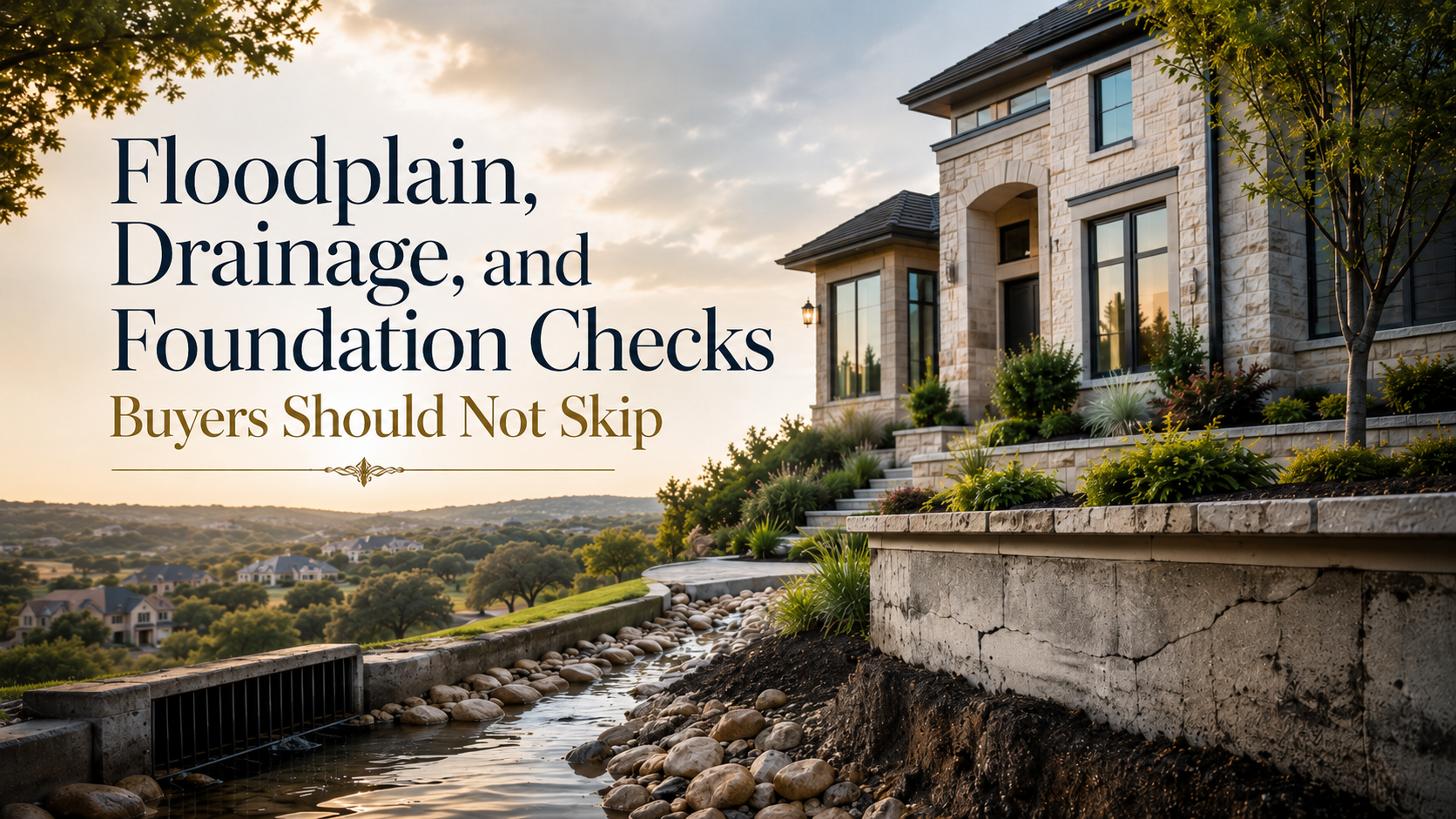
Before buying a home in Garden Ridge or the San Antonio area, investigate three separate issues: the official FEMA flood designation, how water actually moves across the lot and surrounding streets, and whether the foundation shows signs of adverse performance. A standard home inspection helps, but flood maps, local records, insurance quotes, and specialist evaluations may also be necessary. an look perfectly dry during a sunny afternoon showing. The yard is neatly maintained, the flooring looks level, and there is no obvious water staining inside.
Then a strong South Central Texas rain arrives.
Water may collect near the slab, flow across the driveway, back up behind a retaining wall, or enter a street that depends on a ditch, culvert, inlet, or drainage channel. Cracks that appeared minor during the showing may deserve a closer look once they are considered alongside drainage patterns and foundation performance.
That does not mean every low spot, crack, or flood-zone designation should stop a purchase. It means buyers should understand the property before deciding what risks, maintenance, insurance costs, and repairs they are willing to accept.
Why do floodplain, drainage, and foundation checks matter?
These three subjects are closely connected, but they are not the same.
A floodplain review asks whether the property or structure is located within an officially mapped flood-hazard area.
A drainage review asks where rainfall travels across the lot, neighboring land, street, roof, driveway, and surrounding terrain.
A foundation review asks how the structure is currently performing and whether visible conditions suggest movement, deterioration, or another concern that deserves further evaluation.
A buyer can receive reassuring information in one area and still discover concerns in another. A home may be outside a mapped high-risk flood zone but experience water accumulation from poor grading. A property may drain reasonably well but have signs of previous foundation movement. A home may have completed foundation repairs but still need better water management around the structure.
The safest approach is to review all three issues separately and then consider how they interact.
What should buyers check first?
Before becoming fully committed to a property, buyers should complete an initial review of the following:
- The FEMA flood designation for the exact address
- Whether the structure, parcel, driveway, or access route is affected
- The seller’s flood-related disclosures
- Available elevation certificates or map-change documents
- Past foundation or drainage repairs
- Visible slopes, low areas, ditches, swales, culverts, and retaining walls
- Gutters, downspouts, erosion, and soil levels around the foundation
- The home inspector’s opinion regarding foundation performance
- Flood-insurance availability and estimated premiums
- Whether further evaluation by an engineer, surveyor, or drainage professional is appropriate
The FEMA Flood Map Service Center is the official public source for National Flood Insurance Program flood-hazard information. FEMA also emphasizes that there is no true “no-risk” flood zone; areas may have lower or moderate risk without being risk-free. o you check whether a home is in a floodplain?
Start with the exact property address
Search the address through the FEMA Flood Map Service Center and review the dynamic map or FIRMette. Record the flood zone, map panel, effective date, and any available amendments or Letters of Map Change.
A static flood map may not reflect later amendments or revisions. FEMA’s dynamic map incorporates National Flood Hazard Layer information and applicable map changes, making it a better starting point than an old screenshot or listing attachment. ely only on a pin placed near the property. Determine whether the designation affects:
- The home itself
- A detached structure
- Part of the lot
- The driveway or primary access
- A creek, drainage channel, or low area near the property
A surveyor, engineer, floodplain administrator, lender, or insurance professional may be needed when boundaries or elevations are unclear.
Understand what “100-year floodplain” means
The phrase does not mean flooding happens only once every 100 years. It describes an area with a 1% chance of the base flood being equaled or exceeded in any given year. FEMA states that a structure within a Special Flood Hazard Area has approximately a 26% chance of experiencing flood damage during a 30-year mortgage term. tinction matters because buyers sometimes dismiss the risk based on the name alone.
Look beyond the federal map
FEMA mapping is essential, but it should not be the only source reviewed.
For properties in San Antonio and Bexar County, the San Antonio River Authority provides a Floodplain Viewer using FEMA National Flood Hazard Layer data and regional engineering information. en Ridge and other Comal County properties, buyers may also contact the appropriate city office and the Comal County Engineer’s Office. Comal County regulates development within its regulatory floodplain and specifically encourages buyers to verify floodplain information when purchasing property. nfels maintains floodplain-management and drainage resources, including information connected to its Drainage Area Master Plan. erties in Schertz, Cibolo, Seguin, or unincorporated Guadalupe County, the correct source may be a municipal floodplain administrator, city drainage department, or Guadalupe County Environmental Health Department. Jurisdiction matters, especially when a property lies within an extraterritorial jurisdiction rather than city limits. e seller’s disclosure enough?
The seller’s disclosure is important, but it should be treated as the beginning of the buyer’s investigation rather than the end.
Texas seller disclosures include flood-related questions under Texas Property Code Section 5.008. TREC’s current seller-disclosure form is designed to satisfy those statutory requirements. hould carefully review any entries involving:
- Floodplain location
- Previous flooding or water penetration
- Flood-related insurance claims or proceeds
- Drainage concerns
- Foundation movement or repair
- Retaining walls
- Previous structural inspections
- Prior remediation or engineering work
The seller generally reports what the seller is aware of. The disclosure is not a substitute for an independent map review, inspection, insurance quote, or specialist evaluation.
When available, buyers may also request supporting documents such as repair invoices, engineering reports, drainage plans, elevation certificates, warranties, permits, and Letters of Map Amendment or Revision.
Can a house flood even when it is outside a high-risk FEMA zone?
Yes. Being outside a mapped Special Flood Hazard Area does not mean a property cannot experience flooding, ponding, runoff, or water intrusion.
FEMA states that there is no “no-risk” zone. Guadalupe County similarly cautions that small streams, gullies, culverts, dry channels, and low-lying land can flood even when they appear harmless during dry weather. why buyers should study actual site conditions rather than stopping after a flood-zone lookup.
Potential concerns can include:
- Water flowing from higher neighboring land
- A street that drains toward the property
- An undersized or obstructed driveway culvert
- A low garage, patio, or side yard
- Roof runoff discharging beside the foundation
- Soil or landscaping that blocks intended drainage
- Water collecting behind a retaining wall
- A swale that has been filled or altered
- New development that changes upstream runoff
- An addition, pool, driveway, or patio that changes drainage patterns
A dry lawn during a showing cannot demonstrate how the property performs during sustained or intense rainfall.
What drainage problems should buyers look for?
Walk the entire exterior rather than focusing only on the front elevation and backyard entertaining areas.
Look at the slope around the foundation
The ground should not visibly direct water toward the home. Watch for low areas, erosion channels, exposed roots, displaced mulch, sediment lines, standing water, or soil piled unusually high against the exterior.
Pay particular attention to:
- Corners where roof sections meet
- Areas below roof valleys
- Air-conditioning equipment pads
- Hose bibs and irrigation heads
- Exterior doors and garage entries
- Patio and pool-deck transitions
- Retaining walls
- Additions and enclosed porches
- Locations where the lot slopes toward the home
Examine gutters and downspouts
Gutters should be securely installed and capable of moving roof water toward an appropriate discharge point. Downspouts that release water immediately beside the slab may contribute to repeated saturation or erosion.
A gutter system is not automatically required on every home, and its design should be evaluated in the context of the roof, site, soil, and surrounding drainage.
Study the street and driveway
In Garden Ridge, Schertz, Cibolo, New Braunfels, and surrounding areas, a property may rely on some combination of curbs, inlets, bar ditches, culverts, swales, or open drainage channels.
Check whether:
- The driveway interrupts a drainage path
- A culvert appears crushed, blocked, undersized, or heavily silted
- Water marks or debris collect at the road edge
- The street is higher than the garage or home entrance
- A nearby low-water crossing affects access
- Neighboring driveways redirect runoff
- The home has only one practical access route during heavy rain
This review should remain on the subject property or public areas unless permission is obtained to enter neighboring land.
What does a standard Texas home inspection cover?
Texas inspectors have meaningful responsibilities, but buyers should understand the limits of a standard inspection.
Under the TREC Standards of Practice, an inspector must provide a written opinion regarding foundation performance and generally report visible indicators used to form that opinion. Those indicators may include non-latching doors, sloping floors, separations, cracks, and movement in masonry cladding. rs must also report deficient drainage around the foundation, deficient grade levels, and deficiencies in installed gutters and downspouts.
However, a standard inspection does not require the inspector to determine area hydrology, locate underground water, or determine the efficiency and performance of underground or surface drainage systems. itation is important. A good inspection is a critical step, but it is not a full drainage-engineering or flood-risk study.
Which foundation warning signs deserve attention?
One small crack does not automatically mean a home has serious foundation failure. Materials expand, contract, settle, and age.
The concern increases when multiple indicators appear together or when the inspector reports possible adverse performance.
Watch for combinations such as:
- Doors that bind or no longer latch
- Noticeably sloping or uneven floors
- Cracks extending through interior finishes and exterior masonry
- Separation between walls, ceilings, cabinets, or trim
- Windows that are difficult to operate
- Rotating or displaced brick or stone veneer
- Repeated patching in the same areas
- Gaps at exterior framing or rooflines
- Prior piers or foundation-repair components
- Drainage problems concentrated near the affected portion of the home
The goal is not to diagnose the structure during a showing. The goal is to recognize when a licensed inspector or structural engineer should evaluate it more closely.
When should a buyer hire a structural engineer?
A structural engineer may be appropriate when:
- The inspector reports adverse foundation performance
- The property has extensive or repeated movement indicators
- Previous foundation work was completed
- Repair documents are missing or unclear
- The buyer needs an independent opinion on repair scope
- A retaining wall may affect the structure
- Drainage and foundation concerns appear connected
- The buyer needs better information before negotiating or proceeding
A foundation-repair company may provide useful information and estimates, but its role differs from that of an independent structural engineer. Buyers should understand who is providing the opinion, what was evaluated, and whether the provider has a financial interest in recommending repairs.
What records should buyers request?
Depending on the property, useful records may include:
- Seller’s disclosure notice
- Prior inspection reports voluntarily provided by the seller
- Structural-engineering reports
- Foundation-repair contracts and diagrams
- Transferable warranty information
- Plumbing evaluations connected to foundation work
- Drainage or grading plans
- Retaining-wall permits
- Floodplain-development permits
- Elevation certificates
- Letters of Map Amendment or Revision
- Flood-insurance information
- Invoices for water remediation or drainage improvements
- Municipal or county permit records
Missing records do not prove there is a problem, but they may affect how much independent verification a buyer wants before moving forward.
How can flood risk affect insurance and financing?
Most standard homeowners policies do not cover flood damage. Flood coverage is generally obtained separately through the National Flood Insurance Program or a private flood insurer. surance is required for most federally backed or regulated mortgage loans when the structure is located in a Special Flood Hazard Area. FEMA also recommends considering coverage in moderate-risk areas. can vary substantially based on the property, building characteristics, coverage, elevation, flood risk, deductible, and insurer. Buyers should obtain an address-specific quote rather than relying on the seller’s current premium or a general estimate.
An insurance quote should be requested early enough that the buyer can consider the cost before relevant contract deadlines expire.
Do drainage or foundation concerns always make a home a bad purchase?
No. Many concerns are manageable when the buyer understands the condition, receives qualified advice, and accounts for the expense.
The more useful questions are:
- What is causing the condition?
- Is it active, historical, or cosmetic?
- What repair or maintenance is recommended?
- Is the work urgent?
- What will it cost?
- Are permits or engineering plans needed?
- Will insurance or financing be affected?
- What documentation will a future buyer expect?
- Does the purchase price reflect the risk and condition?
A repaired foundation with clear engineering records, drainage improvements, and a meaningful warranty may be easier to evaluate than an apparently untouched home with unexplained movement.
Likewise, a mapped flood designation does not automatically make a property unsuitable. It may, however, affect insurance, construction options, maintenance, financing, and resale.
When should buyers complete these checks?
Before making an offer
Complete a preliminary flood-map review and look at the street, lot elevation, driveway, visible drainage paths, and surrounding terrain.
During the option or due-diligence period
Review disclosures and records, hire the inspector, obtain an insurance quote, and schedule any needed foundation, drainage, plumbing, surveying, or engineering evaluations.
Before the applicable deadline
Obtain written findings, repair estimates, insurance information, and professional recommendations. Decide whether to proceed, negotiate, request repairs, or exercise available contractual rights.
Before closing
Confirm that agreed repairs were completed, collect warranties and reports, verify insurance requirements, and retain relevant property records.
Contract rights and deadlines vary. Buyers should rely on their signed contract and obtain legal advice when they have questions about their rights or obligations.
A practical buyer checklist
Before purchasing a home in the San Antonio or Texas Hill Country area:
- Search the exact address on the FEMA Flood Map Service Center.
- Check the applicable city, county, or regional floodplain viewer.
- Review the seller’s flood, water, drainage, and foundation disclosures.
- Walk the full property perimeter and observe surrounding elevations.
- Examine streets, ditches, swales, culverts, inlets, and access routes.
- Hire a qualified Texas inspector.
- Read the inspector’s foundation opinion and drainage findings carefully.
- Obtain specialist evaluations when findings exceed a standard inspection.
- Request repair, permit, warranty, and engineering records.
- Obtain flood-insurance and homeowners-insurance quotes early.
- Estimate both immediate repairs and ongoing maintenance.
- Make the decision based on documented facts rather than assumptions.
How Correa Realty Group Can Help
Floodplain, drainage, and foundation questions can become overwhelming because the information may come from several different sources. A buyer may be reviewing a FEMA map, seller disclosure, survey, inspection report, insurance quote, county record, and engineering recommendation at the same time.
Correa Realty Group helps buyers organize that information and identify the next practical questions to ask. We can help coordinate inspections, locate available property records, communicate with the appropriate parties, track contract deadlines, and discuss how documented conditions may affect the offer, negotiations, monthly cost, and future resale.
We serve Garden Ridge, San Antonio, New Braunfels, Schertz, Cibolo, and surrounding communities throughout Northeast San Antonio and the Texas Hill Country.
Our role is not to replace an inspector, engineer, surveyor, attorney, lender, or insurance professional. It is to help you assemble the right team, understand the real estate process, and make a decision with greater clarity.
If you are considering a property and have questions about its floodplain designation, drainage, inspection findings, or foundation history, contact Correa Realty Group for thoughtful local guidance.
Serving people, honoring stories.
Frequently Asked Questions
Is checking the FEMA flood map enough before buying a home?
No. A FEMA flood-map search is an essential starting point, but it does not evaluate every drainage or water-related risk on the property. Buyers should also review the lot’s slope, street drainage, roof runoff, culverts, swales, retaining walls, seller disclosures, local records, and available insurance information. FEMA states that there is no true no-risk flood zone, so a property outside a mapped high-risk area may still experience runoff, ponding, or flooding. o I check the flood risk of a Garden Ridge property?
Start with the FEMA Flood Map Service Center using the exact property address. Then determine which municipal and county records apply to the property. Garden Ridge is in Comal County, and the Comal County Engineer’s Office maintains floodplain-development information and advises buyers to verify floodplain conditions when purchasing property. A survey, elevation certificate, map-change letter, or professional evaluation may be needed when the structure or parcel is close to a mapped boundary. flood map should I use for a San Antonio-area home?
Use the FEMA Flood Map Service Center as the official federal starting point. For San Antonio and Bexar County, also review the San Antonio River Authority Floodplain Viewer, which displays FEMA National Flood Hazard Layer data and regional floodplain information. Local city or county resources may provide additional permit, drainage, watershed, road-closure, or infrastructure information. The proper source depends on whether the property is in a city, county, or extraterritorial jurisdiction. house outside the 100-year floodplain still flood?
Yes. A home outside the mapped 1%-annual-chance floodplain may still experience flooding, runoff, ponding, or water intrusion. FEMA states that no flood zone is completely risk-free. Smaller creeks, culverts, gullies, low areas, street drainage, blocked swales, and intense rainfall can create risks that are not obvious during dry weather. Buyers should combine official maps with an on-site drainage review, seller disclosures, local records, and insurance guidance. drainage warning signs should I look for during a showing?
Look for standing water, low areas, erosion, sediment lines, displaced mulch, soil piled against the exterior, downspouts discharging beside the slab, blocked ditches, damaged culverts, leaning retaining walls, and streets that slope toward the home. Also notice whether the garage, doors, patio, or foundation appears lower than surrounding ground. These observations do not provide a diagnosis, but they can identify questions for the inspector or a drainage professional.
When should I hire a structural engineer before buying a house?
Consider a structural engineer when the inspector reports adverse foundation performance, multiple movement indicators are present, previous foundation repairs lack clear documentation, or drainage and structural concerns appear related. An engineer may also help when the buyer needs an independent opinion about repair scope rather than only a repair-company estimate. The engineer should be given available inspection reports, repair diagrams, warranties, surveys, and drainage information so the opinion is based on the fullest available record.
How much can floodplain, drainage, or foundation issues affect a home’s value?
The effect depends on the severity, cause, documentation, insurance cost, repair expense, financing impact, and how future buyers may view the property. A manageable drainage correction is different from repeated structural water intrusion or an unresolved foundation condition. Buyers should obtain property-specific insurance quotes and written repair estimates before assigning a dollar amount. Clear engineering records, permits, completed repairs, and transferable warranties may reduce uncertainty but do not eliminate the need for independent evaluation.
When should I complete flood, drainage, and foundation checks?
Begin the map and visual review before making an offer when possible. Complete inspections, insurance quotes, document reviews, and specialist evaluations during the contract’s option or due-diligence period. Buyers should have the major findings and realistic cost estimates before the applicable negotiation or termination deadlines. Waiting until appraisal or the final days before closing can leave too little time to investigate concerns or evaluate available choices.
Is flood insurance required when buying a home near San Antonio?
It is generally required for most federally backed or regulated mortgage loans when the structure is located in a Special Flood Hazard Area. It may not be required by the lender in a lower-risk zone, but coverage can still be considered because standard homeowners insurance generally excludes flood damage. Requirements and premiums depend on the property, lender, policy, and insurer, so buyers should obtain an address-specific quote early in the transaction. can a real estate agent help with these concerns?
A knowledgeable real estate agent can help identify which records and professionals may be needed, coordinate access, track contract deadlines, organize reports, and communicate repair or negotiation requests. The agent should not diagnose a foundation, determine hydrology, interpret engineering conclusions beyond their expertise, or guarantee insurability. The greatest value comes from helping the buyer gather qualified information and consider how the findings relate to the contract, purchase price, monthly cost, and long-term ownership plans.
Check out this article next