



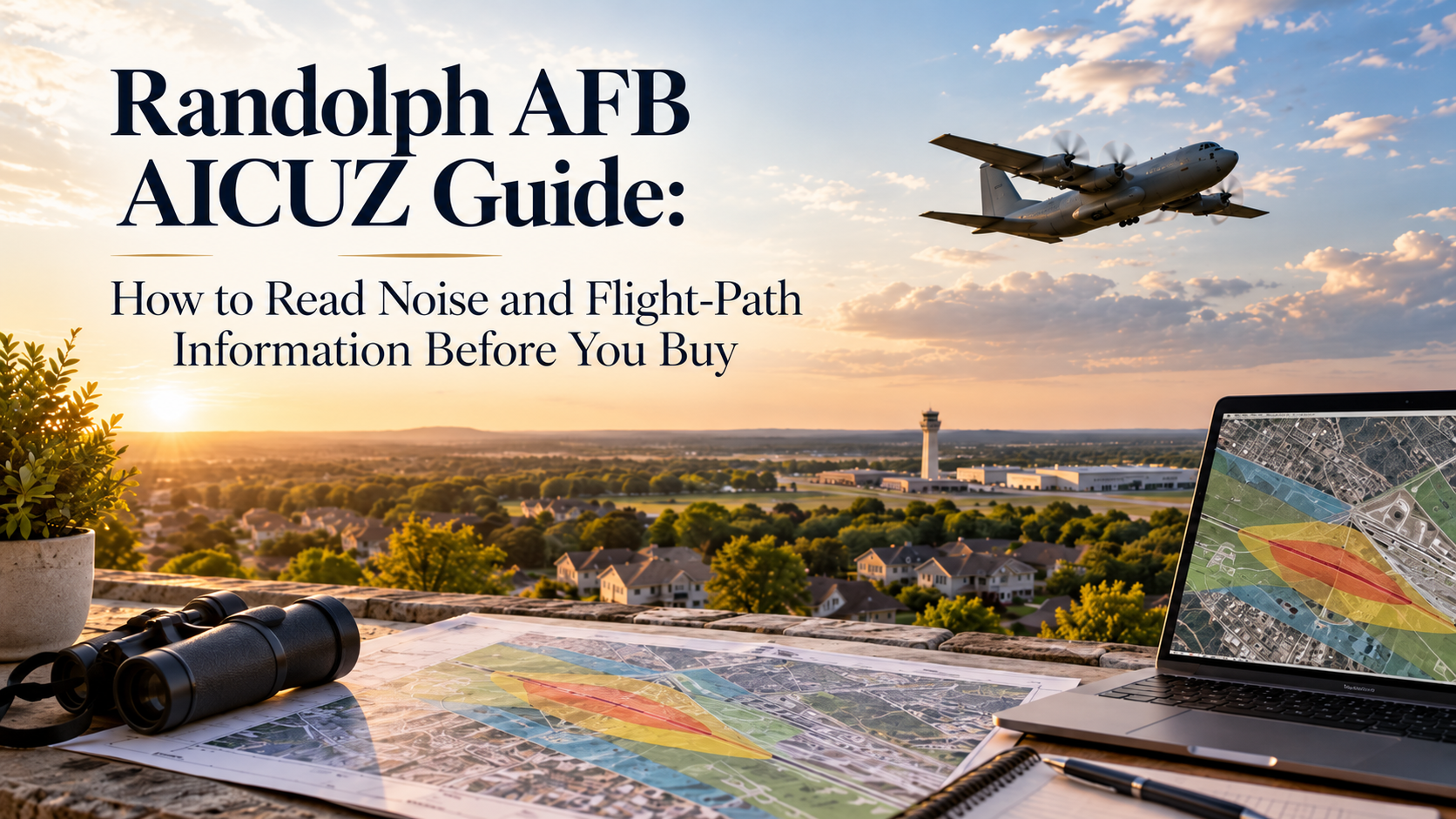
Before buying near Randolph AFB, check the property’s exact location against the official Randolph AICUZ information, understand any Clear Zone or Accident Potential Zone designation, and review the applicable noise contours. Then treat those maps as a starting point—not a guarantee of future aircraft activity—because JBSA-Randolph’s T-7A transition is underway and the Air Force plans updated acoustic modeling as operations increase.
A home can feel wonderfully quiet when you tour it at 11 o’clock on a Saturday morning.
That does not necessarily tell you what the same backyard, home office, patio, or bedroom will sound like during a different operating period at nearby JBSA-Randolph.
For buyers looking in Universal City, Schertz, Converse, Selma, Northeast San Antonio, Cibolo, or even farther out toward Garden Ridge, aircraft activity is one of those property-specific questions that deserves to be investigated before you fall in love with the house—or at least before your due-diligence window starts ticking.
Fortunately, you do not have to rely only on “I heard a jet while I was there” or “the seller says it’s usually quiet.”
There is official information available. The challenge is knowing what it does—and does not—tell you.
The first important distinction is that AICUZ zones, noise contours, and flight paths are not the same thing. A home can be outside an Accident Potential Zone and still experience aircraft noise. A home can be outside a 65 DNL noise contour and still hear individual aircraft clearly. And a line on a planning map is not a promise that every aircraft will follow one exact track every day.
For a buyer, the goal is not to decide whether living near Randolph is universally “good” or “bad.” It is to understand the particular property well enough to decide whether its location and aircraft environment work for you.
What is AICUZ, and why does it matter when buying near Randolph AFB?
AICUZ stands for Air Installations Compatible Use Zones.
The Department of Defense created the program to encourage compatible development around military airfields. It addresses aircraft noise, Clear Zones, Accident Potential Zones, and other land-use considerations so local communities can plan around an operating military installation while the installation can continue its mission.
An AICUZ study is therefore a planning and land-use compatibility tool. It is not, by itself, a verdict that a particular house is unsafe, undesirable, or a poor investment.
It also is not the same thing as a city zoning map. The Air Force develops compatible-use recommendations; local governments make their own land-use and development decisions within their authority. Texas law separately requires certain local governments associated with military installations to make the most recent AICUZ or Joint Land Use Study information, or a link to it, publicly available.
For Randolph, Universal City provides a particularly useful official tool: its AICUZ webpage links to an address-searchable mapping application where a buyer can check whether a home or business falls within a Clear Zone, APZ 1, or APZ 2 identified by the 2017 Randolph AICUZ study.
That is much more useful than looking at a city name and guessing.
What do Clear Zone, APZ 1 and APZ 2 mean?
These areas deal primarily with accident potential and compatible land use along runway approaches and departures, rather than being measurements of how loud an individual aircraft will be.
The Department of Defense developed the zones using historical aircraft accident locations and debris patterns. They identify areas of differing relative accident potential near runway ends.
For JBSA-Randolph, Universal City summarizes the official zone geometry this way:
| AICUZ area | What it means |
|---|---|
| Clear Zone | Area immediately beyond an active runway end. Randolph's Clear Zone extends 3,000 feet outward and is intended to remain undeveloped. |
| APZ 1 | Rectangular area beyond the Clear Zone, 3,000 feet wide and 5,000 feet long along the extended runway centerline. |
| APZ 2 | Rectangular area beyond APZ 1, 3,000 feet wide and 7,000 feet long along the extended runway centerline. |
Those dimensions and definitions come directly from Universal City's official Randolph AICUZ resource.
The practical lesson for a home buyer is simple:
Do not use “near the base” as a substitute for checking the parcel.
APZs extend outward from runway ends in defined areas. Two properties that seem similarly close to Randolph on a road map can have very different AICUZ relationships depending on where they sit relative to a runway centerline.
Is an AICUZ zone the same thing as a noise zone?
No.
This is probably the most important distinction in the entire discussion.
Clear Zones and APZs address accident potential and compatible land use. Noise contours describe modeled cumulative aircraft-noise exposure. A property can be outside the APZs and still hear aircraft, sometimes distinctly.
When you look at an aviation noise map, you may see contours expressed in DNL, or Day-Night Average Sound Level.
DNL is not the loudest sound you might hear from a jet passing overhead.
The FAA describes DNL as a 24-hour equivalent sound level based on annual aircraft operations. Individual aircraft events are combined mathematically, with nighttime operations receiving additional weighting. The federal significance threshold commonly used in aviation noise analysis is 65 DNL.
That means a buyer should not interpret “65 DNL” as:
“The loudest sound at this house will be 65 decibels.”
It does not mean that.
The FAA specifically notes that a homeowner can experience individual events measuring substantially above the DNL number because a single-event sound reading and a cumulative DNL value measure different things.
A useful way to think about it is:
A DNL contour is a long-term noise-exposure model, not a maximum-volume line.
Does being outside the 65 DNL contour mean the house will be quiet?
No.
A house outside a 65 DNL contour may still experience noticeable aircraft noise.
The FAA says noise experienced at a particular residence can vary with the aircraft fleet, the property's proximity to a flight path, aircraft altitude, weather, and other operating conditions.
That matters when you are touring homes near Randolph.
A buyer might reasonably decide that occasional aircraft noise is no concern at all. Another buyer who works from home, records audio, spends significant time outdoors, or is simply more noise-sensitive may evaluate the same conditions differently.
Neither reaction is wrong.
What matters is making the decision with enough information that you are not surprised after closing.
Is the AICUZ map a Randolph AFB flight-path map?
Not exactly.
An AICUZ study can show the relationship between airfield operations, noise exposure, Clear Zones, APZs, and surrounding land uses. It should not be interpreted as a promise that every aircraft will follow one thin, permanent line over the ground.
Aircraft tracks can vary because of operating configuration, wind and weather, altitude, mission requirements, and air-traffic considerations. The FAA notes that weather and other operating variables can influence where aircraft are experienced around an airport.
That distinction becomes even more important at Randolph because the Air Force is changing its training aircraft.
The Air Force's T-7A Record of Decision states that Randolph T-7A operations may also use Seguin Auxiliary Airfield, JBSA-Lackland's Kelly Field, and existing designated training airspace.
The same environmental decision discusses adjustments to portions of flight patterns as a noise-mitigation measure. In other words, operational patterns are something the Air Force can evaluate and modify; they should not be viewed as permanently frozen lines on a residential map.
So when someone asks, “Is this house under the Randolph flight path?” the most accurate answer may require more than a yes or no.
A better set of questions is:
Where is the property relative to the runway approaches, APZs, and modeled noise contours? What aircraft activity is observable at the property? And could the operating environment change as the mission evolves?
Why does the T-7A matter to buyers in 2026?
This is where current research matters.
JBSA's environmental resource page currently lists the 2017 Randolph AICUZ study as the posted AICUZ document. That study grew out of an update process begun in 2016 and published for the then-current Randolph flying environment.
But the aviation environment is now changing.
The Air Force decided to replace the T-38C with the T-7A Red Hawk at JBSA-Randolph, and the third T-7A delivered to the installation arrived on August 25, 2026.
That does not mean buyers should disregard the 2017 AICUZ study.
It means buyers should understand what the date represents.
The 2017 map remains the official AICUZ study currently provided on JBSA's environmental page, while the T-7A is a newer operational change. The Air Force's Record of Decision specifically says that as T-7 aircraft are delivered and operations increase, acoustic models are to be rerun so potential impacts can be more accurately defined, with adaptive management and revised flight operations available when needed.
That is a significant piece of due diligence for today's buyer.
The responsible way to use the 2017 AICUZ map in 2026 is as an authoritative planning baseline—not as a guarantee that future noise exposure will remain identical to what was modeled in 2017.
The T-7 environmental analysis also evaluated substantial future training activity and discussed noise mitigation, including reducing afterburner use in the modeled mitigated action and modifying portions of flight patterns. Those figures were environmental-planning scenarios, not a statement of the exact number or timing of flights a homeowner is experiencing today.
That distinction matters. It keeps the conversation factual without either minimizing or exaggerating what future operations may mean.
What should a buyer actually check before making an offer?
Start with the exact address, not the neighborhood name.
First, use the official Randolph AICUZ resources and the Universal City address-searchable map to determine whether the property is shown in a Clear Zone, APZ 1, or APZ 2. Then review the complete Randolph AICUZ study for applicable noise information.
Next, treat the map as one part of a broader property investigation.
A practical buyer review should include:
- checking AICUZ/APZ information for the exact parcel;
- reviewing the available noise contours;
- reading the seller's disclosure carefully;
- visiting the home at more than one time of day when possible;
- spending time both inside and outside the home;
- observing how much sound is noticeable with windows open and closed;
- considering patios, pools, work-from-home spaces, bedrooms, and other areas where noise may matter to you;
- comparing nearby resale activity rather than assuming a universal “base-noise discount”; and
- checking for updated Air Force or local-government information if the transaction occurs after this article is published.
No single step provides the whole answer.
What does the Texas seller's disclosure tell you about military installations?
Texas law gives buyers another clue, but it should not be mistaken for a parcel-specific AICUZ determination.
The seller's disclosure provisions in Texas Property Code §5.008 include a military-installation notice warning that a property may be near a military installation and may be affected by high noise, an AICUZ, or other military operations.
That is useful notice.
But it does not replace checking the actual property against official mapping.
A generalized military-installation warning does not necessarily tell you:
- whether the parcel is in APZ 1 or APZ 2;
- where it lies relative to a particular DNL contour;
- how often you personally will notice aircraft;
- whether future operations will change; or
- whether the noise level fits your own preferences.
Think of the disclosure as a prompt to investigate further, not as the end of the investigation.
What should Garden Ridge buyers know?
For Garden Ridge buyers, the important lesson is not to make assumptions based only on a city name or driving distance from Randolph.
If aircraft noise or military flight activity is important to your decision, check the actual property rather than deciding that Garden Ridge is automatically “far enough away” or assuming that every location in the broader Northeast San Antonio market experiences the same conditions.
Noise contours are based on modeled operating patterns, while individual aircraft can be heard beyond a particular contour depending on route, altitude, aircraft type, weather, and other variables.
That same property-specific approach is useful when comparing a Garden Ridge home with homes in Schertz, Cibolo, Selma, Universal City, or Northeast San Antonio.
A five- or ten-minute difference in drive time does not answer an aviation-noise question.
The map and the property do.
What about Schertz, Universal City, Converse and Northeast San Antonio?
These are exactly the kinds of markets where buyers should be comfortable doing address-level research.
Universal City has gone a step further by publishing the official Randolph AICUZ explanation and linking to an interactive address lookup for the 2017 study's Clear Zone and APZ designations.
Schertz's relationship with Randolph aviation is not new, either. JBSA reported in 2016 that Schertz installed signs informing residents about local flight operations as part of compatible-use efforts around the installation.
The point is not that every home in one of these communities has the same exposure. Quite the opposite.
AICUZ due diligence should be address-specific.
One side of a community, subdivision, or road may have a different relationship to runway alignment or operating patterns than another.
Can you tell from one home tour whether aircraft noise will bother you?
Usually, one visit gives you only one sample.
It may be useful—but it is still a sample.
If noise sensitivity could affect your decision, try to see and hear the property under different conditions before committing whenever the transaction timeline allows.
You might return during a weekday, spend several minutes outside rather than immediately walking indoors, and pay attention inside without the television or music running.
You are not trying to conduct a professional aviation noise study.
You are answering a more practical question:
“Can I comfortably live with what I am hearing here?”
That is something a map cannot decide for you.
Will being near Randolph AFB hurt resale value?
There is no responsible universal percentage that can answer that question for every property.
Aircraft noise may matter to some future buyers and matter very little to others. At the same time, proximity to major employment centers and transportation corridors can also be relevant to a buyer's location decision. The net effect on a specific property's marketability has to be evaluated in the context of the actual home and actual comparable sales—not a blanket assumption.
For a property where AICUZ or aircraft activity is a material concern, a useful market analysis may compare:
similar homes in the same market, their mapped locations, sale prices, time on market, condition, lot characteristics, and other important differences.
Even then, correlation is not proof that aircraft exposure caused a price difference. Real estate has too many overlapping variables for that kind of shortcut.
The practical question is not “Does military noise always reduce value?”
It is:
“How has the market treated comparable homes with a similar location and exposure?”
That is a much better question for a buyer—or a seller preparing to list.
Should aircraft noise automatically stop you from buying near Randolph?
No.
Nor should it automatically be dismissed.
Some homeowners are entirely comfortable living near an active military installation. Others prefer a different sound environment.
A buyer's job is not to adopt somebody else's tolerance.
It is to understand what comes with the property.
That includes what is known today, what official planning documents show, and what may reasonably be evolving.
With Randolph in particular, the 2026 transition to T-7A training makes that last point important. The Air Force has expressly planned to collect operational information and update acoustic modeling as T-7 operations develop.
A careful buyer therefore does not ask for a guarantee that flight patterns will never change.
No real estate professional, seller, neighbor, or map can responsibly give that guarantee.
Instead, make a decision that still feels comfortable knowing that you are buying near an active military flying mission.
A simple Randolph AFB due-diligence rule
If there is one idea worth remembering, it is this:
Check the map, check the exact address, experience the property, and account for the fact that military operations can evolve.
AICUZ gives you important planning information.
DNL contours help you understand modeled cumulative noise.
The seller's disclosure provides another notice.
An in-person visit tells you how the property feels to you.
Current Air Force information helps you understand whether the operating environment is changing.
Put those pieces together before you make the decision—not after closing.
How Correa Realty Group Can Help
Buying in the Randolph area sometimes requires looking beyond square footage, updates, and commute time.
Correa Realty Group can help buyers work through the property side of this due diligence by identifying the exact address on available AICUZ resources, distinguishing an APZ question from a noise-contour question, reviewing seller disclosures, researching comparable sales, and helping you think through what to investigate before making an offer.
For homes where aircraft activity is an important consideration, we can also help you build time into your search to experience the property more than once when circumstances allow and identify questions that may need to go to the seller, lender, appraiser, title company, municipality, or another appropriate professional.
We will not tell you that aircraft noise “won't matter,” and we will not tell you a home is a bad choice simply because it is near Randolph.
The better approach is to give you reliable information and enough local context to make the choice for yourself.
That reflects how we approach real estate throughout Garden Ridge, San Antonio, New Braunfels, Schertz, Cibolo, and the surrounding communities: serving people, honoring stories, and helping clients make decisions with their eyes open.
When you are considering a home near JBSA-Randolph and want help researching the location before you make an offer, contact Correa Realty Group for local, property-specific guidance.
Frequently Asked Questions
What is AICUZ near Randolph AFB?
AICUZ is a Department of Defense compatible-land-use planning program for areas around military air installations. For JBSA-Randolph, it addresses aircraft noise, runway Clear Zones, Accident Potential Zones, and related land-use considerations. It is intended to help the Air Force and surrounding communities plan compatible development rather than serve as a home-buying rating system. Buyers should use AICUZ information to understand a property's relationship to the airfield, then combine it with current operational information and their own observations at the property.
How do I know whether a house is in a Randolph AFB Accident Potential Zone?
Check the exact address against official Randolph AICUZ mapping rather than estimating from distance to the base. Universal City's official AICUZ page links to an address-searchable mapping application for the 2017 Randolph study that identifies Clear Zone, APZ 1, and APZ 2 locations. Because those zones follow extended runway centerlines, properties that appear similarly close to Randolph can have different AICUZ relationships. Verify the parcel itself before making an offer.
Does being outside the 65 DNL noise contour mean I will not hear aircraft?
No. A home can be outside a 65 DNL contour and still experience clearly audible aircraft events. DNL measures cumulative sound exposure over an average day based on annual operations; it is not the maximum decibel level of an individual flyover. The FAA notes that aircraft noise at a particular residence can vary with flight-path proximity, altitude, weather, and aircraft mix. That is why an in-person visit is useful even when a home is outside a mapped contour.
Do Garden Ridge buyers need to check Randolph AFB noise and flight information?
Yes, when aircraft activity is an important personal consideration, it is worth checking the exact Garden Ridge property rather than assuming distance alone answers the question. Noise contours describe modeled cumulative exposure, while individual aircraft may be noticeable beyond a contour depending on altitude, route, aircraft type, and weather. A Garden Ridge buyer comparing homes there with Schertz, Cibolo, Selma, or Northeast San Antonio will get better information from property-level research than from broad citywide assumptions.
What should San Antonio-area buyers know about the T-7A at Randolph?
The T-7A transition is now underway, so buyers should recognize that Randolph's operating environment is evolving. The Air Force is replacing the T-38C with the T-7A at JBSA-Randolph, and the third T-7A delivered to Randolph arrived in August 2026. The Air Force's environmental decision also calls for acoustic models to be rerun as T-7 operations increase, with adaptive management available if operational changes are needed. The currently posted Randolph AICUZ study is from 2017, so both sources deserve consideration.
Can Randolph AFB flight paths change after I buy a house?
Yes, buyers should not assume aircraft will always follow one unchanging ground track. Aviation activity can vary with operational configuration, weather, altitude, mission requirements, and other flight considerations. The T-7A environmental decision itself discusses potential adjustment of flight-pattern segments as part of noise mitigation and says updated operational information will be collected as the new aircraft enter service. Buy with the understanding that you are near an active military flying mission rather than relying on a guarantee about one current flight pattern.
Does living near Randolph AFB lower a home's value?
There is no defensible one-size-fits-all percentage by which proximity to Randolph or aircraft noise changes home value. Market reaction can depend on the exact property, its mapped exposure, neighborhood competition, condition, price point, lot, and the preferences of future buyers. A better approach is to examine relevant closed comparable sales and, where the data allows, compare properties with similar characteristics and locations. Avoid assuming that an AICUZ designation automatically produces a particular dollar discount—or that aircraft activity has no resale significance at all.
When should I check AICUZ information when buying a home?
Ideally, review AICUZ and noise information before making an offer when the property's location near Randolph is material to your decision. That gives you time to evaluate the home without the pressure of an already-running contract timeline. If you learn about the issue only after contracting, investigate it promptly during whatever negotiated due-diligence opportunities apply to your transaction. Texas seller-disclosure provisions also contain a military-installation warning, but that notice is not a substitute for checking the exact parcel yourself.
When can a real estate professional help with Randolph AFB due diligence?
Professional real estate guidance can be particularly useful when you need to connect aviation information to a specific property and its market context. An experienced local agent can help locate official AICUZ resources, identify questions raised by seller disclosures, research comparable sales, and help you arrange property visits at useful times. For aviation modeling, legal interpretation, appraisal, lending, title, or municipal-rule questions beyond the agent's role, the appropriate specialist should be consulted. The goal is coordinated due diligence—not having one person pretend to be an expert in every discipline.
Check out this article next